Showing posts with label Sappho. Show all posts

15 July 2026

San Francisco Opera: Pride Concert


I did not attend last year's Pride Concert at San Francisco Opera, but I did attend this year's, which was announced as the second annual. The very full house was very full of enthusiasm, & if I didn't quite share it, well, that's pretty much on me, now isn't it?

I make a somewhat snobbish point of not going to Opening Night at the Opera, but I imagine it's similar to this concert: there's a packed house, & a lot of buzzy energy & excitement, but it's not really of the "here for the music" variety, but more about a hoped-for "scene"; also, there are speeches! For someone who has devoted so much life & love to the theater, I acknowledge that's it's weird that speeches from the stage cause me immediate distress, but, once again, that's pretty much on me, isn't it. So there were speeches. For anyone playing Buzzword Bingo, it took barely ten minutes before we heard "being your authentic self". Oh, & the performance start-time was 8:00 rather than the Opera's usual 7:30, for reasons unclear to me.

The performers were stellar: Robert Mollicone led the Opera Orchestra, with Sapphira Cristál as our masterly Mistress of Ceremonies, with vocal soloists Melody Moore (soprano), Nikola Printz (mezzo), & Reginald Smith Jr (baritone), along with a back-up trio (or, as I thought of them, the Pips), Sadie Cheslak (mezzo), Alexa Frankian (soprano), & Thomas Kinch (tenor). All were top-notch, & often even better than that. Their commitment & enthusiasm were palpable. There were many stylish & fun costume changes, especially from our Emcee, of course, & glitter & sparkles & vivid colors were everywhere – except, unfortunately, in the musical selections.

Not that things were all bad on that front. We started with a tribute to the late & much-loved Michael Tilson Thomas in the form of Agnegram, a lively & eclectic piece he wrote to honor a rich & I'm sure lovely Symphony patron, Agnes Albert. As with the other pieces I've heard by Tilson Thomas, it is entertaining but strikes me as a bit ramshackle & a bit derivative (in this piece I particularly heard echoes, of, though perhaps I should say "an homage to", Charles Ives). I enjoyed it but was mildly surprised to realize in retrospect that it would turn out to be one of the musical highlights of the evening.


Mme Cristál was tireless & I think accomplished what she set out to do, which was offer inspiration & uplift as well as introductions & context. It was all more high-minded than I was expecting; I never thought I would long for a drag performer to be snarkier & smuttier. I thought some of the context given was unnecessary, but then perhaps I am not understanding who exactly the target audience was. I do think that if a San Francisco Opera audience, particularly one gathered for a Pride Concert, really needs to be told who Sappho of Lesbos was & why she is significant, then we should just give up on humanity. That explanation came as an introduction to Ô ma lyre immortelle from Gounod's opera Sapho, which is based on the familiar story of Sappho ending her life by jumping from a cliff into the sea over despair for a male lover, Phaon. Our emcee seemed to suggest that this story was something invented by Gounod, or the nineteenth century in general, to cover up the truth of Sappho's love for women. It was all done in that very knowing, mmm-hmmm, right, we know the real story way.

But this incident has been part of Sappho's life (or, more accurately, legend) since classical times. Even Ovid, a "queer" author only in the broadest sense but one certainly open to sexual difference & aware of varied sexual options, gives us this story. I don't know offhand what the story's source is (it certainly predates Ovid) & I assume it's considered an embellishment rather than a biographical fact, insofar as we can determine what those are based on the fragments & remnants of such a different time & place, but in a way none of that matters: it has always been part of Sappho's story, & nonetheless she was still identified strongly & mainly as a lover of other women, lending her name & her island's name to all her daughters.

Why does this matter, & why did Cristál's approach depress me? Because it just illustrates our need to put people into boxes & to keep them there. Sappho could be mainly a lover of women but also have an affair with a man without betraying herself (or, for that matter, us, as if it's any of our concern anyway). Oscar Wilde, after all, was married & had two children. In both cases, their basic preference is clear & defining: but why dismiss their other experiences, unless it's our need to categorize, to classify, to limit? Despite all of our talk about embracing the variety of our feelings & the individual's right to choose his / her/ their own representation, we still crave definite & defining answers to the often irrelevant question, What's going on down there?

Having said all that: Printz gave a stunning, passionate performance of the aria, & at the end the singer (or director E Reed Fisher, or both) had the wonderful idea of having them extend their blue garment & cape out into a Loïe Fuller-style serpentine dance, illustrating the waters swirling over the poet's head. Very effective! I've heard Printz in several performances recently, & they consistently dominate the stage.


This is not to slight the other singers. Before the Gounod we heard Melody Moore give a touching performance of Lucky from Stephen Schwartz's opera Séance on a Wet Afternoon. He's known for musicals, particularly Wicked (as well as Godspell & Pippin) & based on this aria & what I know of his other works, he's more at home in the world of musical theater. After the Gounod, Smith gave a probing rendition of Peculiar Grace from Terence Blanchard's Fire Shut Up in My Bones, an aria about the tricky expectations for & from a young Black man who is grappling with his sexuality. That was followed by Moore giving a wrenching performance of La mamma morta from Giordano's Andrea Chénier, which seemed to be on the program mostly because it appears in a pivotal moment in Philadelphia, a movie I had almost forgotten about (I've never actually seen it), about a man dying of AIDS. I wondered how many in the audience were familiar with this 33-year-old film. Like many of the pop-culture callbacks during the evening, this one seemed weirdly dated. Nonetheless I was glad to hear the aria, no matter what ushered it into the line-up. After that Moore & Printz gave us a lovely, lilting rendition of the Barcarolle from Offenbach's Tales of Hoffmann, & I am always happy to hear Offenbach, especially performed so beautifully; the sensual languor of this particular piece stood out amid the uplift & the anthems.

After the Offenbach, things got even more pop-centric, starting with Be the Change by Michael Abels, who worked with Rhiannon Giddens on the opera Omar (my thoughts on that opera are here). Omar,  I thought, was trying to do some complex & subtle things; this song, which the program book described as "in the spirit of protest anthems & communal uplift songs", is not. It's like a campfire song that high-minded counselors urge on those who find Kumbaya too emotionally complex to deal with. This was the first song on which the Pips joined in. The two women, Cheslak & Frankian, were quite enthusiastic; Kinch seemed a bit off the beat & a bit more tentative in his gestures, which I found quite endearing. I enjoyed the trio, a feeling in line with my experience throughout this concert of enjoying the performances more than what was being performed.

The thing is, I mostly dislike (often verging, I will admit, on hate), pop / rock / rap, & I resent having it forced on me, just because I have to live in the world: going to the gym, the coffee shop, the grocery store, on public transit, walking down the street, even just sitting in my own residence: other people's boring trashy taste gets forced on me at inescapable volume. I hate the attitude that we all need to genuflect before the (corporate-sponsored) altar of pop culture. A few years ago I was at a piano recital in which the jazz-influenced pianist performed some wonderful pieces & then, for an encore, did a Michael Jackson song. It deflated my evening immediately. Musically it was the least interesting piece he performed. And the attitude seemed to be that now that we'd eaten our classical vegetables, we'd get the sticky sweet pop treat that we were truly craving. It had all been so enjoyable up until then! (It doesn't help that Jackson is one of those 1980s cultural figures whose popularity I did not get then & continue not to get, along with Madonna, Keith Haring, Princess Diana, & probably others I'm forgetting.)

I stopped listening to pop music in the early 1980s, because I found it increasingly vacuous & irritating, like trying to live on nothing but Doritos. Sure, the occasional bag is fun, & they do have different flavors thanks to the wonders of chemistry, but on the whole, there's a lot out there that's more enticing, complex, & interesting, as well as more nourishing to body & soul. But despite switching the station decades ago, I knew many of the songs performed during this concert, which made me wonder what was guiding the repertory choices. Even I know there are more current pieces that would be worth doing for a Pride concert (surely at least one of the 69 Love Songs by the Magnetic Fields could have made the cut?). Couldn't the choices have reflected a wider range of moods & decades?

We were given The Joke by Brandi Carlisle (& three others, according to the program book), sung by Moore. It's pretty much an "it gets better" song, & the refrain ends "I have been to the movies, I've seen how it ends / And the joke's on them". Here's the thing: a movie, like any dramatic structure, including a concert program, is an artistic arrangement of the often perverse, nebulous, infuriating, & frustrating realities of life into a shape that we can find emotionally & morally satisfying. In other words, saying to me, "I've seen this movie & here's how it ends" is not persuasive, outside of the context of characters in a movie. The lyrics just don't hold up to even a cursory examination of how life really happens; they're about trying to jolly everyone into optimism by overlooking reality. We all know people who were bigots & bullied those who were seen as weak or different, & no, they did not always get their comeuppance, even in the form of a less than successful life. And anyone of a certain age knows people who made their little jokes & jabs about queerness when we were all young (& therefore more susceptible to jokes & jabs, & back when such remarks were more socially acceptable & prevalent, & when "queer", now reclaimed, was an outright insult), & now those same people, come each June, are wreathing their social media with rainbows & glittery unicorns & reposting Love Is Love memes. And they probably think they were with you all along. Sure, why not. Life is slippery & people are elusive &, as Didion reminds us, we all tell ourselves stories in order to live.

One more song from the latter half of the show: Gender Binary (F*ck You) by Ryan Cassata, performed by Nikola Printz. Why the dainty fig-leaf of an asterisk in the title (as printed in the program book)? If you're going to sing Fuck, why not print it in a straightforward way? The asterisk is a nod to a transgressive power that that word lost years ago. While agreeing wholeheartedly with the intent & spirit of the song (which fights back against all kinds of insistence on fitting people into pre-made gender boxes: so see my comments above on the story of Sappho & Phaon), the message, though Printz's fiery performance really put it across, is pretty basic & fairly crude & simple. It's coming from a punk-rock attitude, but, again, punk was around when I was still listening to what I'll just call pop music, & it all seems too dated to be genuinely shocking.


Most of the songs were enjoyable, though not really engaging to my ears: the ones I haven't mentioned so far were Constant Craving, made famous by k d lang, sung by Moore & Printz; How Will I know, made famous by Whitney Houston, sung by Smith & the Pips; I Can Only Be Me, made famous by Stevie Wonder, sung by Printz; Any Love, made famous by Luther Vandross, sung by Smith & the Pips; Let It Rain, made famous by Tracy Chapman, sung by Smith (this one stood out, in a good way); & a finale sung by everyone, a medley of Greatest Love of All, Everybody Rejoice (A Brand New Day), & I'm Coming Out.

The focus was solidly on songs that might be called "anthems", songs that offered uplift & positivity. These were songs in which uncertainty ends in true love & rejection is a fear but never a reality. This was not a night for ambiguity, broken hearts, & never ever quite fitting in. Sure, I get it: we're all under siege by the ascendant reactionaries & fascists & just by life in general, & maybe uplift is called for. I would have hoped that an audience at the Opera would be given repertory that is of greater musical interest, but perhaps others found this program just the thing to give them the strength to go out & fight, or at least to dance into Pride weekend in the rainbow-bedecked foggy city. I would have preferred another approach. I'm usually reluctant to say that an artist should have given us something different from what he / she / they chose to give, but: couldn't whoever put the program together find some material that was more interesting & varied? some standards to repurpose, something by Cole Porter, or Rodgers & Hart, or even Rodgers & Hammerstein (I'm thinking of We Kiss in the Shadows from the King & I)? A simple gender-flip in the singer can give a new & refreshingly queer slant to even a familiar song (here are links to YouTube videos of Aaron Tveit singing Mein Herr from Cabaret & As Long As He Needs Me from Oliver!). Couldn't we have had even one song, just one little number, by the late &, as is increasingly obvious, very great Stephen Sondheim?

After two solid intermissionless hours of uplift, I have to say the audience was as enthusiastic as ever, heading into the lobby for the after-party, the throbbing monotonous thumping of which further depressed me. Nothing can send me racing for the exit faster than the presence of a DJ.

I don't understand what it means to live "authentically" (before anyone tries to explain it to me: I understand what it means in this context; it means not hiding basic facts about your gender & sexual identities – but I find authentic & authenticity slippery & problematic words, &, particularly when it comes to our sexualities, I question how much we need or should show to others). I don't really like uplift: I just see too many other possibilities. I don't really believe in daily affirmations (maybe I should try them?). I dislike being told that I'm oh so special (or that, in a nod to the latest pop-culture inevitabilities, being different is my superpower), because that's just the nice way of telling me I'm a weirdo & a freak who doesn't fit in with others. I don't believe in "communities" based on coincidental characteristics. And as always when I say things like this, I need to add that I do not think that feeling this way makes me "better" than anyone else. I don't regret going to the concert. You go so you can know, & now I know. Many others seemed to be perfectly satisfied with the bill of fare, & I'm always glad when people enjoy themselves, as long as I can get to the exit.

12 March 2018

Museum Monday 2018/11


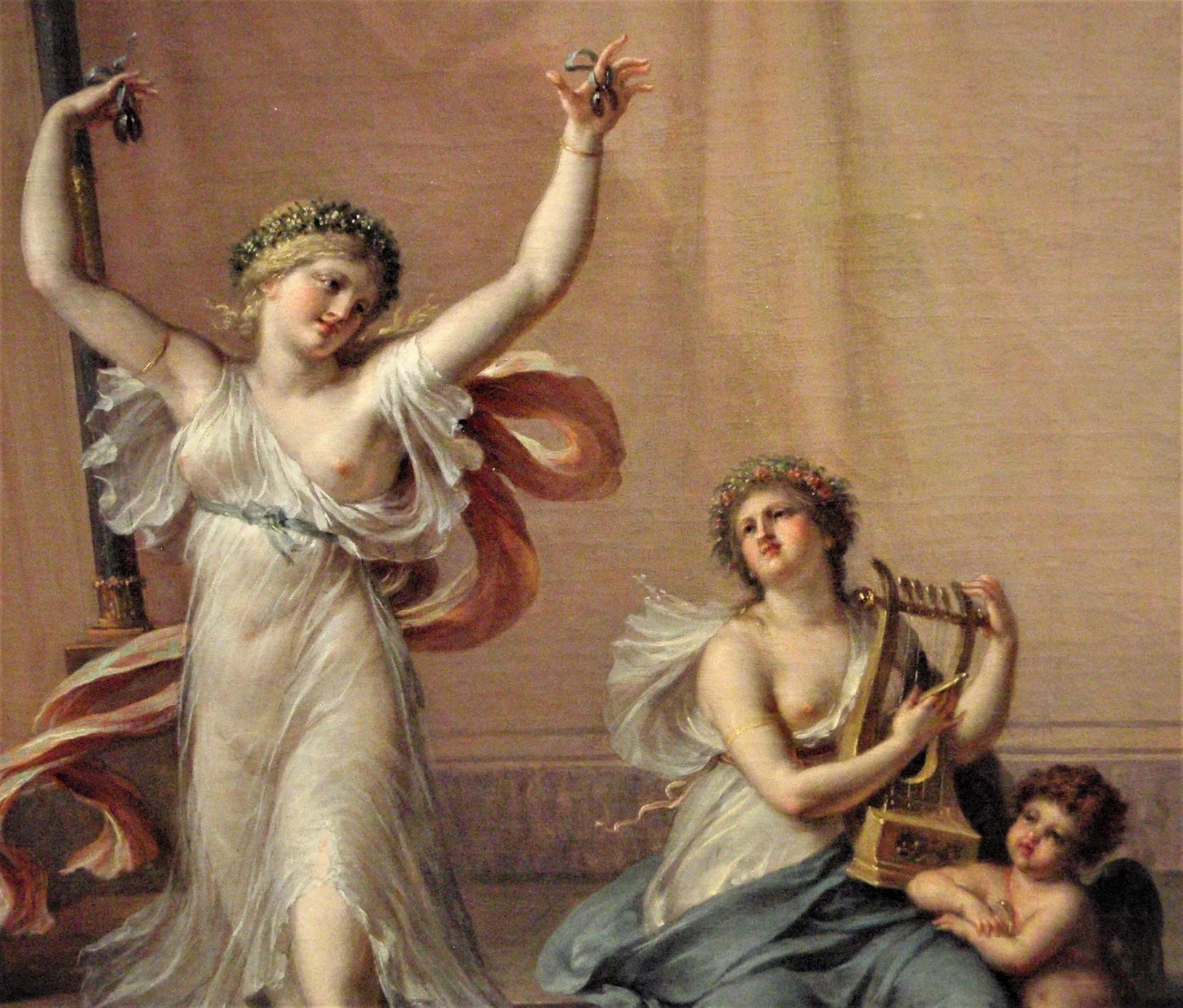
detail of Anacreon, Sappho, Eros, and a Female Dancer by Étienne de Lavallée-Poussin, in the Utah Museum of Fine Arts, Salt Lake City

05 September 2016

Poem of the Week 2016/36

Well, this "no computer" thing is certainly dragging on . . . but I'm hoping to have good (or goodish) news soon.

More Sappho, translated by Mary Barnard:

In memory

Of Pelagon, a fisherman,
his father Meniscus placed

here a fishbasket and oar;
tokens of an unlucky life

Sappho

29 August 2016

Poem of the Week 2016/35

This computer thing is dragging on much longer than I was hoping it would. Soon, soon, I keep telling myself: soon. . . . Here's some more Sappho, once again translated by Mary Barnard:

And I said

I shall burn the
fat thigh-bones of
a white she-goat
on her altar

Sappho

22 August 2016

Poem of the Week 2016/34

I have finally received the diagnosis on my computer, and the news is not good. Motherboard meltdown! So now I have to deal with the trouble and expense of getting a new one.

Sappho, translated by Mary Barnard:

It is clear now:

Neither honey nor
the honey bee is
to be mine again

Sappho

15 August 2016

Poem of the Week 2016/33

Still no computer. I know, I know: how do I manage? Where do I get this incredible inner strength? Here's another Sappho fragment, once again in the Mary Barnard translation:

The gods bless you

May you sleep then
on some tender
girl friend's breast

Sappho


08 August 2016

Poem of the Week 2016/32

Computer crisis continues. . . though I'm hopeful things will be up and running again soon. In the meantime, here's another fragment from Sappho as translated by Mary Barnard. Since I'm on a Chromebook borrowed from V, I let her pick the poem. And here it is:

If you will come

I shall put out
new pillows for
you to rest on

Sappho

Nice choice, Miss V!

01 August 2016

Poem of the Week 2016/31

The computer crisis continues, so once again I call on Sappho (in the Mary Barnard translation) for the weekly poem:

Many's the time

I've wished I, O
gold-crowned
Aphrodite,
had luck like that

Sappho

25 July 2016

Poem of the Week 2016/30

My computer has been dead in the water (metaphorically) since last Thursday. I am not sure when my regular contact with civilization (in the shape of the Internet) will be restored. As I wander the wastelands without e-mail, without Amazon, without Netflix, without you-get-the-picture, I still want to give you a poem for Monday morning, so here is a beautiful fragment from Sappho (in Mary Barnard's translation):

Day in, day out

I hunger and
I struggle.

Sappho

20 June 2016

Poem of the Week 2016/25

To a Song of Sappho Discovered in Egypt

           And Sappho's flowers, so few,
            But roses all.
                                       MELEAGER

Jonah wept within the whale;
But you have sung these centuries
Under the brown banks of the Nile
Within a dead dried crocodile:
So fares the learned tale.

When they embalmed the sacred beast
The Sapphic scroll was white and strong
To wrap the spices that were needed,
Its song unheard, its word unheeded
By crocodile or priest.

The song you sang on Lesbos when
Atthis was kind, or Mica sad;
The startled whale spewed Jonah wide,
From out the monster mummified
Your roses sing again.

Your roses! from the seven strands
Of the small harp whereon they grew;
The holy beast has had his pleasure,
His bellyful of Attic measure
Under the desert sands.

Along strange winds your petals blew
In singing fragments, roses all;
The air is heavy on the Nile,
The drowsy gods drowse on the while
As gods are wont to do.

Leonora Speyer

There is no actual Biblical authority for saying that Jonah wept in the belly of the whale; in the King James version, he does cry, but in the sense of crying out, in an urgent appeal or entreaty: I cried by reason of mine affliction unto the Lord (Jonah, 2:2). Perhaps Speyer was misremembering, or misread the passage. Perhaps she could not resist the alliteration of wept within the whale. Or perhaps she merely invented the detail (which is entirely plausible) as part of her poem's exploration of the connections and contrasts between religious texts and sacred rituals and the love poems of Sappho.

Although there have been some recent papyrus discoveries of previously unknown fragments by Sappho, this poem, published in 1926, refers to then-new fragments found in what are known as the Oxyrhynchus papyri, for the town in Egypt near which they were found. It's difficult and sad to realize that until fairly recently we had even less of Sappho's poetry than the fraction known today, but then much of the classical past is lost or known only in fragments. Even a celebrated and influential author like Menander, exponent of Greek New Comedy (and thereby father of Plautus, Terence, commedia dell'arte, Molière, and numerous romantic comedies) and with a special aura of Christian-era wisdom as the sole pagan author quoted by St Paul, was known only by stray fragments until the late 1950s, when the Dyskolos (The Misanthrope) was found in close to complete form. There are still discoveries waiting to be made.

Anyway: until these discoveries, much of Sappho's mystique came from her very high reputation in the ancient world, exemplified here by the epigraph from Meleager (this would be Meleager of Gadara, a poet and early founder of the collection of verse that become known as The Greek Anthology). Throughout this lyric Speyer will develop his comparison of Sappho's poems to the rose, generally considered the flower of all flowers, at least among poets.

Speyer begins by contrasting the weeping of Jehovah's reluctant prophet Jonah, hidden within the whale, with the silent singing of the Sappho manuscript inside another water creature, a crocodile (many of the Oxyrhynchus papyri had been used in the mummification of crocodiles; not surprisingly for a creature associated with the life-giving Nile, the crocodile was sacred, an avatar of the god Sobek). Despite the presence of these water creatures (the whale and the crocodile) and the watery tears of Jonah, Speyer creates a sense of dryness and desiccation in the scene: we have the brown banks of the Nile and the dead dried crocodile; in both cases alliteration increases the emphasis on the words. So fares the learned tale: that's what happens to things outside the ordinary, perhaps, or perhaps the reference is to Sappho's relatively obscure and archaic Aeolic dialect, which was less familiar than the standard Attic dialect.

To the priests mummifying their dead reptile, the white and strong (like a Greek column) scroll was merely handy and suitable material. The priests are equated with the dead crocodiles; both are deaf to the personal, emotional songs (when Atthis was kind, or Mica sad) found on the scroll. Speyer compares her wonderfully vivid startled whale spewing Jonah wide (again, she makes music with alliteration: startled / spewing and whale / wide) with the monster mummified releasing Sappho's poems. There is a contrast between the sacred history's reluctant prophet of Jehovah and the poems, described as beauteous roses surreally singing again. But there's also an equivalence in dignity and importance, despite what the ancient priests thought; actually, this poem tends to tip towards the ancient love poems.

The lyric ends with two rhapsodic stanzas continuing the comparisons between the Sappho fragments and the desert world of priests and mummies. The papyrus fragments would themselves be browned and fragile, but Speyer transfigures them into roses, working off of Meleager's ancient praise, and the fresh and lovely petals contrast with the desert sands and the heavy air. Speyer reminds us of the performative nature of Sappho's poems: all of them were originally sung, by soloist or chorus, to the accompaniment of a small harp, an instrument that became associated with Sappho (hence the reference here to the seven strands / Of the small harp). Sappho's ancient fragments are made to seem fresh to us by the comparison to roses, as opposed to the strange, even alien world of the holy beast hidden under the desert sands. The "roses" that slept in these fragments awaken and are spread abroad again, alive and singing, in contrast to the Egyptian gods: while the new ancient poems are spread abroad, the drowsy gods drowse on; the repetition drowsy / drowse helps reinforce the sense of, well, drowsiness, of lethargic half-sleeping semi-dreaming somnolence. This is, Speyer tells us, as gods are wont to do: in the final line, the silent mysterious world of the Egyptian priests (and, by implication, the Judeo-Christian tradition drawn in by the initial mention of Jonah in the whale), the withdrawn and invisible divinity of the gods, is contrasted with the everlasting livingness and love of the poet's art.

I took this poem from the Library of America collection American Poetry: The Twentieth Century, Volume One: Henry Adams to Dorothy Parker, edited by Nathaniel Mackey, Marjorie Perloff, and Carolyn Kizer.

18 August 2014

Poem of the Week 2014/34

I am still recovering from my summertime flu – I'm functional, but minimally – so here are some more Sappho fragments. This time there are two, and they're the ones Dorothy Burr Thompson adapted for The Dancers, which we saw earlier this year, so you can do some compare-and-contrast.

In the spring twilight

The full moon is shining:
Girls take their places
as though around an altar

*************

And their feet move

Rhythmically, as tender
feet of Cretan girls
danced once around an

altar of love, crushing
a circle in the soft
smooth flowering grass

Sappho

These are again from the Mary Barnard translation. Dorothy Burr Thompson's version is from Swans and Amber: Some Early Greek Lyrics Freely Adapted and Translated.

11 August 2014

Poem of the Week 2014/33

I had something else planned for this week and then a nasty virus knocked me flat for several days, so I am once again calling on Sappho to see me through:

My lovely friends

How could I change
towards you who
are so beautiful?

Sappho

Lovely readers, take this beautiful fragment as thanks from me. This is from the Mary Barnard translation.

05 May 2014

Poem of the Week 2014/19

The Dancers

Under the light of the Cretan moon
The maidens are dancing together in tune,
They dance together the dances of Crete,
Round the altar with delicate feet,
Delicate feet that lightly pass
Treading the delicate bloom of the grass.

Sappho, "freely translated and adapted" by Dorothy Burr Thompson

It's only the beginning of May but it feels as if spring is drawing to a close, at least here in the Bay Area; we've already had some unpleasantly hot days that left the plants as wilted and dusty as they left me, and our year-long lack of rain means the dewy fresh greenery is already turning sere, even with our local fog. So I wanted to get in this lovely combination of some Sapphic fragments while it seemed timely rather than ironic. Spring is not explicitly mentioned here, but I feel the season is evoked in "the delicate bloom of the grass" and there is a very vernal feel to the maidens dancing under the moon, perhaps exactly because they are maidens (in the sense of young, virginal women) and because of the aura of delicacy and lightness, which seems appropriate to the beginning of things (as opposed to the ripeness and maturity and even heaviness one would expect if that were a harvest moon). Thompson evokes the circular movement of the dance by using repetition: the "light of the Cretan moon" is reflected later on as the maidens' feet "lightly pass," and the "Cretan moon" itself gets reflected in the "dances of Crete"; the girls are "dancing together in tune, / They dance together the dances of Crete" and they go round the altar "with delicate feet / Delicate feet that lightly pass / Treading the delicate bloom of the grass"; and note also how many of these phrases are joined with the alliterative sound of d. The poem has a lilting, dance-like rhythm, and each line of each couplet ends with the double bar of an accented syllable. (The term for this sort of rhyme, in which the stress falls on the final syllable, is masculine rhyme, which is sort of comical for a poem that evokes women dancing under the moon, but then these names – to complete the set, feminine rhymes end with one or two unaccented syllables after the beat – somewhat arbitrarily reflect gender roles in a way that makes me think there must be other, less loaded terms that are replacing them. If there are, I haven't heard them yet, for though I sometimes hear them called strong and weak rhymes, that seems under the circumstances more like an objectionable euphemism than an improvement.)

I took this from a collection with the gorgeous title Swans and Amber: Some Early Greek Lyrics Freely Adapted and Translated by Dorothy Burr Thompson.

26 March 2014

Poem of the Week 2014/13 (part 3)

Sappho: Fragment 104, variations on a theme

Part 1 may be found here and Part 2 here.

Here are some poems that reference in various ways Sappho's evening star fragment. These are all from English-language traditions, so for example Catullus 62 is not included. They are presented in the order in which they were first (to the best of my knowledge) published.

Oh Hesperus, thou bringest all good things:
   Home to the weary, to the hungry cheer,
To the young bird the parent's brooding wings,
   The welcome stall to the o'erlaboured steer.
Whate'er of peace about our hearthstone clings,
   Whate'er our household gods protect of dear
Are gathered round us by thy look of rest;
Thou bring'st the child, too, to the mother's breast.

from Don Juan, Canto III, stanza 107, Lord Byron (1821)

A moment of rest in a turbulent poet. Incorporating a well-known classical fragment was a recognized flourish in a poem, and not considered plagiarism, or the result of inadequate original ideas. The reader is supposed to notice the borrowing and admire the way the poet has referenced, repurposed, or extended the original. And unlike the related practice in earlier times of re-using Greek or Roman ruins as material with which to build new walls or fences, the original was not only left unharmed, but was enhanced by the prestige of becoming a poetic trope.

*************

Low-flowing breezes are roaming the broad valley dimm'd in the gloaming:
Thoro' the black-stemm'd pines only the far river shines.
Creeping thro' blossomy rushes and bowers of rose-blowing bushes,
Down by the poplar tall rivulets babble and fall.
Barketh the shepherd-dog cheerily; the grasshopper carolleth clearly;
Deeply the wood-dove coos; shrilly the owlet haloos;
Winds creep; dews fall chilly: in her first sleep earth breathes stilly:
Over the pools in the burn water-gnats murmur and mourn.
Sadly the far kine loweth: the glimmering water outfloweth:
Twin peaks shadow'd with pine slope to the dark hyaline.
Low-throned Hesper is stayed between the two peaks; but the Naiad
Throbbing in mild unrest holds him beneath in her breast.
The ancient poetess singeth, that Hesperus all things bringeth,
Smoothing the wearied mind: bring me my love, Rosalind.
Thou comest morning and even; she cometh not morning or even.
False-eyed Hesper, unkind, where is my sweet Rosalind?

from Leonine Elegiacs, Alfred Tennyson (1830)

This is an early poem by Tennyson, later dropped by him from his official catalogue. Instead of extending and elaborating Sappho's lines, as Byron did, Tennyson refers to her and quotes her lines, with the further dismayed reflection that life does not always work the way poetry does. Hyaline at the end of line 10 means something having a glassy, translucent appearance, so presumably the reference is to a lake. And of course it's there to rhyme with pine in the middle of the line. There's some fancy mid-line/end-line rhyming going on throughout this poem. I wonder if the water-gnats murmuring and mourning in line 8 flew in from the Keats ode To Autumn.

*************

Happy bridegroom, Hesper brings
All desired and timely things.
All whom morning sends to roam,
Hesper loves to lead them home.
Home return who him behold,
Child to mother, sheep to fold,
Bird to nest from wandering wide:
Happy bridegroom, seek your bride.

from Epithalamium in Last Poems, A E Housman (1922)

An epithalamium is a song or poem written to celebrate a wedding. Housman, by profession a classics scholar, exuberantly plays on that aspect of Sappho's lines. Poets love to add birds to this fragment. Birds are always poetical.

*************

The Evening Star
Penelope's maidens sing of the old father of the absent Odysseus yearning for his son's return:

His eyes toward the even
     Age ever turns
Where fair in the heaven
     Hesperus burns:
Hesper the herald
     Who brings to their rest
Sheep to the sheepfold,
     Babe to the breast;
For Hesper will gather
     What Eos hath strown:
The son to his father,
     The prince to his own!

from The Songs of Sappho, Marion Mills Miller (1925)

As mentioned yesterday, this particular edition of Sappho included prose translations of the Greek, accurate if archaic in style, by David Moore Robinson, along with more fanciful repurposings by Miller: in this case, the lines are imagined as a song for Penelope's maids, singing of Odysseus's father's longing for his son's return, when he will come into his own kingdom. Eos is the goddess of the dawn.

*************

The Evening Star
in memory of Catherine Mercer, 1994 - 1996

The day we buried your two years and two months
So many crocuses and snowdrops came out for you
I tried to isolate from those galaxies one flower:
A snowdrop appeared in the sky at dayligone;

The evening star, the star in Sappho's epigram
Which brings back everything that shiny daybreak
Scatters, which brings the sheep and brings the goat
And brings the wean back home to her mammy.

Michael Longley, included in Sappho Through English Poetry, edited by Peter Jay and Caroline Lewis (1996)

Longley is a contemporary Irish poet. Dayligone means twilight and a wean is a young child. The same lines that served Tennyson for melancholy recriminations and Housman for a joyful song serve Longley as the source of terrible pathos and irony: recollecting Sappho's lines, he also recollects a child that will never come home again.

*************

At the violet hour, the evening hour that strives
Homeward, and brings the sailor home from sea,
The typist home at teatime

from The Waste Land, ll 220 - 222, T S Eliot (1922)

And we'll end with Eliot's sardonic repurposing of Sappho's lines; he even draws attention to the origin in his footnotes to The Waste Land, to make sure you see.

25 March 2014

Poem of the Week 2014/13 (part 2)

Sappho: Fragment 104 x 25

Part 1 may be found here and part 3 here.

The first entry is from the Loeb Classical Library; since their translations are meant to serve as a crib for the original on the facing page, they provide a straightforward, fairly denotative sense of what the words mean, and bearing them in mind you can see what changes are wrought by the different translators. The rest follow according to the date of their first publication (to the best of my knowledge). I've added comments below some of the translations, but have skipped commenting if I've already mentioned something earlier.

Hesperus, bringing everything that shining Dawn scattered, you bring the sheep, you bring the goat, you bring back the child to its mother.

from Greek Lyric I: Sappho and Alcaeus in the Loeb Classical Library, edited and translated by David A. Campbell (1982)

You'll note that in this version the child returns to "its mother": I assume the Greek is gender neutral; as you will see, some translators use its, some use his or hers, and some make the child into children going to their mother.

*************

O Hesperus! Thou bringest all things home;
All that the garish day hath scattered wide;
The sheep, the goat, back to the welcome fold;
Thou bring'st the child, too, to his mother's side.

from Greek Poets in English Verse, translated by William Hyde Appleton (1893)

Like many early translations of Sappho, this one favors not only a regular rhythm but rhyme. Though rhyme was not used by ancient Greek poets, it does help create the sense of a formal structure to the words, which is an important element of the original that is difficult to convey in translation, especially given the fragmentary nature of what survives, which can look very much like free verse. Also, to most late-nineteenth-century readers of English poetry rhyme would signal that the poem is a lyric (unrhymed poetry in English generally being epic, tragic, or at least narrative and lengthy).

*************

Hesperus, bringing together
All that the morning star scattered, –

Sheep to be folded in twilight,
Children for mothers to fondle, –

Me too will bring to the dearest,
Tenderest breast in all Lesbos.

from Sappho: One Hundred Lyrics, translated by Bliss Carman (1904)

Earlier translators of Sappho felt it appropriate to shape what were after all ambiguous remnants into something that felt to them more like a complete poem in line with what they knew or supposed of the poet's personality and work (to add to the complications, my understanding is that many of them were working from inferior or inadequate editions of the Greek). So Carman's version turns the authentic lines into part of a love song, since Sappho had come to be seen as one of the great poets of love. Such an approach to translation was similar to the approach taken to the restoration of paintings or buildings in the late nineteenth and into the early twentieth century, which frequently involved wholesale repainting or rebuilding, often in ways that owed more to current notions of how Old Masters or old churches should look than to historical actuality. This attempt to make the past look current and pristine gradually gave way to the current mode, which is to keep restorations minimal and non-invasive, and to make clear what is an original survival, what a conjecture, and what a blank, even at the expense of smoothness and consistency of style or even of coherence.

*************

Hesper

Thou, Hesper, bringest homeward all
     That radiant dawn sped far and wide:
The sheep to fold, the goat to stall,
     The children to their mother's side.

from Love, Worship and Death: Some Renderings from the Greek Anthology, translated by Rennell Rodd (1919)

Again, we have the use of regular meter, and even more rhyme than in the Appleton version above. And as was common at the time, this version evokes both the distant past and an elevated world of "poetic" diction by using forms that had long dropped out of English speech and prose ("Thou" and "bringest". . . ).

*************

Evening

Children astray to their mothers, and goats to the herd,
Sheep to the shepherd, through twilight the wings of the bird,
All things that morning has scattered with fingers of gold,
All things thou bringest, O Evening! at last to the fold.

from Sappho: A New Rendering, translated by Henry De Vere Stacpoole (1920)

This one reverses the original's order; it starts with the child (made into children), then the goats and sheep, and adds a bird, which are always poetic, all moving towards the Evening (rather than the Evening Star). It's a lovely evocation of the power of nightfall, but to me it loses the emotional impact of ending with the child returning to its mother. It's a very pretty poem, with some extra filigree (which I don't necessarily hold against it, and a bit of what can seem like padding is bound to happen when you're translating into regular meter and rhyme). An approach like this or Carman's goes against our current views of what translation is and should do, but such versions were meant as an honest attempt to recreate the lost work of a great poet, and not just as freehand fantasias on themes from Sappho (which is a legitimate approach to take, only nowadays there would be objections to considering such works translations; sometimes it's a fine line, and tomorrow we'll see some examples).

*************

Hail, gentle Evening, that bringest back
All things that bright morning hath beguiled.
Thou bringest the lamb, thou bringest the kid,
And to its mother her drowsy child.

included in The Songs of Sappho in English Translation by Many Poets, translated by Edwin M Cox (1924)

Beguiled at the end of the second line is clearly there to rhyme with child in the fourth, but it adds an interesting element not found in most of the other versions: the sense that the day's activities have seduced and fooled you, and that what is authentically valuable is only found in "gentle Evening." Again we have the use of archaic diction: "thou bringest" and the Miltonic "Hail."

*************

Hesperus, thou who bringest all things that the bright dawn scattered, thou bringest the sheep, though bringest the goat, thou bringest to the mother her child.

from The Songs of Sappho, translation by David Moore Robinson (1925)

This one was meant as a close prose transcription of the original, in the style of the Loeb Classical Library; even so, it retains the archaic diction of contemporary poetic versions. This particular edition (which advertises itself on its title page as "including the recent Egyptian discoveries") matched Robinson's scholarly versions with more fanciful rhymed recreations/adaptations by Marion Miller (whose version will appear tomorrow).

*************

Evening Star that bringest back all that lightsome
Dawn hath scattered afar; thou bringest the sheep, thou
bringest the goat, thou bringest her child home to the
mother. . .

from You Burn Me, translated by J M Edmonds (1928)

The ellipsis at the end of this version seem like an interesting early attempt to convey the fragmentary nature of what remains of the original (by 1928, of course, Pound and Eliot had already published major work). "Lightsome" is an interesting word; perhaps it's a bit on the obscure side, but it does convey the sense of the rising light of Dawn, as well as nimble, light-hearted, graceful (making this version imply the opposite of the one above that had Dawn beguiling all things; beguiling can mean to while away the time, but there's often a sense that something deceptive or ultimately harmful is going on, whereas lightsome lacks the implications of deception and harm).

*************

To the Evening Star

Evening Star, thou bringest home
All that Dawn had sent to roam,
Back to one another;
Thou bringest the sheep, thou bringest the goat;
Thou bringest the child to his mother.

from Swans and Amber, Some Early Greek Lyrics Freely Translated and Adapted by Dorothy Burr Thompson (1948)

Thompson gives herself a lot of leeway in her versions, which are advertised in her title as both "freely translated" and "adapted," but even so this version seems closer to the original than some of the earlier versions. The third line seems added mostly to provide a rhyme for mother in the last line. I find the line kind of awkward, as if the sheep, the goat, and the child were all returning to each other, instead of to their separate places of rest. Thompson's adaptations in general do have a freshness and charm.

*************

You are the herdsman of evening

Hesperus, you herd
homeward whatever
Dawn's light dispersed

You herd sheep – herd
goats – herd children
home to their mothers

from Sappho: A New Translation, translated by Mary Barnard (1958)

I love Barnard's famous translation of Sappho, which was the first I read, and one of the first to avoid archaic and elevated "poetic" language and attempt to make Sappho speak in modern English, but reading over this one in the context of all these other versions, I'm a bit puzzled by what she's doing here. I'm not sure where she's getting the "herdsman of evening" concept, and while using herd for the sheep and the goats is fine, it sounds both harsh and ludicrous to talk about herding children to their mothers.

*************

Dusk and western star,
You gather
What glittering sunrise
Scattered far,
The ewe to fold,
Kid and nanny home,
But the daughter you send wandering
From her mother.
(                 )
Hesperos, most beautiful
Of stars.

from 7 Greeks, translations by Guy Davenport (1965)

There are a couple of textual variations that appear in this version: first, the papyri are not only fragmentary but often in worn or tattered condition, and there are some scholars who read the last words of our fragment to mean that while evening brings the sheep and the goat home, it sends the child away from its home – the supposition is that the child is a daughter, and this is a song about marriage, in which nightfall sends her away from her childhood home and to her husband's house. Second, Hesperos is the subject of another fragment (often called 104b, making our fragment 104a), which is sometimes taken as part of this poem, and joined to it by some translators, as it is here after the empty parenthesis, used to indicate a break in the text. (The Loeb translation of 104b is "the fairest of all the stars.") Kid and nanny are interesting words to use for the goats, since kid is slang for a child, and a nanny is a child's caretaker as well as a mother goat. These puns (maybe it would be better to call them "word of ambiguous meaning" since pun implies some level of comedy) convey the other version of the text, in which the child goes home to its mother, before offering the alternate version. It kind of underplays the goats though.

*************

Evening Star

Hesperos, you bring home all the bright dawn disperses,
bring home the sheep,
bring home the goat, bring the child home to its mother

[with a footnote: "In [classicist] Bruno Snell's reading the bright dawn brings out the sheep and goat, and the child away from its mother."]

from Sappho and the Greek Lyric Poets, translated by Willis Barnstone (1965)

This is very similar to Barnstone's later version (which we looked at yesterday); his footnote acknowledges the possible different ending of the poem.

*************

Evening Star, you bring back
all that was scattered
in the shimmer of Dawn.
You bring the sheep, you bring the goat, and
you bring her child to the mother.

. . . the most beautiful of all stars

from The Poems of Sappho, translated by Suzy Q. Groden (1966)

This is a straightforward lovely version, with an interesting touch in the last line: most versions have the child returning to her/his/its mother, with an emphasis on the action of the child; this one puts a delicate stress on the mother instead by having the possessive refer to the child, so that the emphasis is on the mother who has been awaiting the child's return. The 1928 Edmonds translation above does the same thing; oddly it struck me more in this version, possibly because Groden's version has a cleaner, more modern sound, making nuances jump out a bit.

*************

Hesperus
you gather all
home
to your breast

from Sappho, translated by Richard O'Connell (1975)

A very stripped-down version, in which Hesperus gathers everything into itself, which seems like an image of death – peaceful death, given that things are gathered home, but still death.

*************

Dusk, you restore all that the glittering dawn has dispersed, –
bringing the sheep, bringing the goats, – but you keep the bride from her mother.

from Three Archaic Poets: Archilochus, Alcaeus, Sappho, translated by Anne Pippin Burnett (1983)

*************

Hesperus, you bring everything that
          the light-tinged dawn has scattered;

you bring the sheep, you bring the goat, you bring
          the child back to its mother.

from Sappho: Poems & Fragments, translated by Josephine Balmer (1984)

*************

Evening Star who gathers everything
shining dawn scattered –
you bring the sheep and the goats,
you bring the child back to its mother.

from Sappho's Lyre: Archaic Lyric and Women Poets of Ancient Greece, translated by Diane Rayor (1991)

Since the repetition of "bring" is a key rhetorical and emotional element of this poem, I'm not sure why the sheep and the goats are lumped together; to me it loses the rhythm.

*************

Hesperus, loveliest of all the stars . . .
bringing back all that glowing Dawn sent forth:
you bring the sheep,
you bring the goat,
you bring the girl to a home away from her mother.

from Greek Lyric Poetry, translated by M L West (1993)

*************

Evening star, you bring back all that the bright dawn scattered,
Bringing the sheep and the goat, and bringing the child to its mother.

from Sappho, translated by Robert Chandler (1998)

*************

Star of Evening

Hesperus
you bring
home everything
which light of day dispersed:
home the sheep herds
home the goat
home the mother's
darling

from The Love Songs of Sappho, translated by Paul Roche (1998)

*************

Evening
     you gather back
          all that dazzling dawn has put asunder:
                                             you gather a lamb
                         gather a kid
gather a child to its mother

of all stars the most beautiful

from If Not, Winter: Fragments of Sappho, translated by Anne Carson (2002)

*************

Hesperos, you bring all that the bright dawn scattered,
the lamb, the kid, the child to its mother.

     fairest of stars

from Sappho: Poems and Fragments, translated by Stanley Lombardo (2002)

*************

Evening Star

Hesperos, you bring home all the bright dawn scattered,
bring home the sheep,
bring home the goat, bring the child home
to her mother.

from Sweetbitter Love: Poems of Sappho, translated by Willis Barnstone (2006)

*************

Most beautiful of all the stars
O Hesperus, bringing everything
the bright dawn scattered:
you bring the sheep, you bring the goat,
you bring the child back to her mother.

from The Poetry of Sappho, translated by Jim Powell (2007)

*************

Hesperus, you are
The most fetching star.
What Dawn flings afield
You bring back together –
Sheep to the fold, goats to the pen,
And the child to his mother again.

from Stung with Love: Poems and Fragments, translated by Aaron Poochigian (2009)

A recent version that uses rhyme, which was, as you have seen, out of favor for several decades. Poochigian's reasoning is that rhyme helps signal to an English-language reader that these are songs, and indeed all of Sappho's poetry was originally meant to be sung, either solo or in chorus, to musical accompaniment. "Fetching" is very clever, meaning both to bring something back and to be attractive and charming, though of course that's a cleverness in the English language that is added to the original.

24 March 2014

Poem of the Week 2014/13 (part 1)

Sappho: Fragment 104

Evening Star

Hesperos, you bring home all the bright dawn scattered,
bring home the sheep,
bring home the goat, bring the child home
to her mother.

from Sweetbitter Love: Poems of Sappho, translated by Willis Barnstone (2006)

Time for another Sapphopalooza! Last time I did this, the only reaction I got was that the number of translations was kind of overwhelming. So this time, there are three entries: the first today, so you can take in the basic poem on its own; the second tomorrow, with 25 different versions and variations, done between 1893 and 2009; the third on Wednesday, in which several poems from the English-language tradition reference this poem in different ways.

When a poem is built on repetition, even slight variations can have a powerful effect. This fragment of Sappho's work survives because it was quoted by an ancient rhetorician named Dimitrios as a charming example of anaphora ("the repetition of a word or phrase at the beginning of successive clauses or verses"). This translation preserves the cumulative power of the repeated words "bring home" (as you shall see tomorrow, not all of them do). Though the strictest, most literal translations do not include the word "home," it seems implicit in the poem's sense of a comforting return, as the day ends, to an intimate and familiar place of refuge.

There's a wonderful balance to these few words, in which Hesperos, the brilliant star of early evening, ends what the sun's bright dawn started: the business of the day in the world outside the home. It is time for wanderers to return home. For of course these lines were written when people mostly had to conduct their public business when the sun was out; night might be broken by bonfires and torches, but their light didn't carry far enough to make the outdoors a particularly safe place to be. And of course in these lines the sheep and the goats are not mere pastoral decoration, but a major source of food, clothing, and wealth; they were what you sacrificed to placate the gods, and what you protected from marauding predators, human and animal. There is a sense here of gathering in the gently, sweetly domesticated products of Nature to a place in which they are valued and safe, which deepens touchingly when the final item is brought home: the child to her mother. The very bareness of the words – "the child home to her mother" – allows us to supply whatever emotion (care, anxiety, gentle love, expectation patient or eager) we would most connect to in such a situation. This translator subtly emphasizes the importance of the child over the sheep and goats, and the importance of the concept of "home," by putting the direct object in this one case in between the words "bring home": it's bring home the sheep and bring home the goat but bring the child home. And only with the child is there a mention of who is waiting at home.

Part 2 may be found here and Part 3 here.

18 November 2013

Poem of the Week 2013/47

I now have a slick and spiffy new computer, but I had no time this week and I'm still getting used to the new computer interface, so here's another brief bit of life wisdom from Sappho. Once again, this is from the Mary Barnard translation.

If you are squeamish

Don't prod the
beach rubble

Sappho, translated by Mary Barnard

04 November 2013

Poem of the Week 2013/45

I'm still trying to deal with my computer situation, so here is a fragment by Sappho to tide us over.

Must I remind you, Cleis,

That sounds of grief
are unbecoming in
a poet's household?

and that they are not
suitable in ours?

Wise words, which I will try to take to heart. The translation is by Mary Barnard. Cleis is Sappho's daughter (mentioned by name in Fragment 132).

03 June 2013

Poem of the Week 2013/23


Sappho: Fragment 47 x 14

The last time I held a Sapphopalooza, we looked at six different versions of what is possibly her only surviving complete poem, the Hymn to Aphrodite. This time I thought it would be interesting to see the many possibilities of one short fragment – really just a simile, about love but grand in the epic style, that survives from an otherwise unknown poem. The oldest version here from my ever-growing collection of Sappho translations is only from the late 1950s. I think earlier periods prized these surviving remnants of the past, but were more likely to see in them antiquarian rather than aesthetic interest; the twentieth century, under the influence of Imagism and other poetics that favor brevity and fragmentation, were more likely to find a remnant like this a satisfactory poem on its own.

And it is indeed a vivid and emotionally complete statement. The translations, though all from a relatively compact period, show a surprising range emotionally (from wonderment to agony and various places in between) and technically (from an emphasis on the fragmentary and dislocated to attempts at recreating the formal structure of the original). Each version reflects a slightly different view of love, of Sappho, of what Sappho should sound like to our foreign ears, and of what makes an effective poem.


 The original was preserved in the Orations of Maximus of Tyre:
Socrates says Eros is a sophist, Sappho calls him a weaver of tales. Socrates is driven mad for Phaedrus by Eros, while Sappho's heart is shaken by Eros like a wind falling on oaks on a mountain; (i.e.):
Ἔρος δ’ ἐτίναξέ μοιφρένας, ὠς ἄνεμος κὰτ ὄρος δρύσιν ἐμπέτων
That quotation is from the Loeb Classical Library text, and so is the first translation below. I'm starting with this one because, as previously noted, the purpose of the Loeb series is to provide a straightforward, fairly denotative guide on the right-hand pages to the original on the left-hand pages, so this version should be a fairly clear guide to the basic meaning of the words. The other translations are arranged alphabetically by the translator's surname; the date after each is the copyright date of the translation. One translator rendered it twice; his come in order of copyright date.

Love shook my heart like a wind falling on oaks on a mountain.
— trans. David A. Campbell, Greek Lyric: Sappho & Alcaeus, 1982

          Love shook my heart
like the wind on the mountain
rushing over the oak trees
— trans. Josephine Balmer, Poems & Fragments, 1984

Without warning

As a whirlwind
swoops on an oak
Love shakes my heart
— trans. Mary Barnard, Sappho: A New Translation, 1958

THE BLAST OF LOVE
Like a mountain whirlwind
punishing the oak trees,
love shattered my heart.
— trans. Willis Barnstone, Sappho and the Greek Lyric Poets, 1962

Eros

Love shook my heart like wind
on a mountain punishing oak trees.
— trans. Willis Barnstone, Sweetbitter Love: Poems of Sappho: A New Translation, 2006


          Eros shook my
mind like a mountain wind falling on oak trees
— trans. Anne Carson, If Not, Winter: Fragments of Sappho, 2002

Desire has shaken my mind
As wind in the mountain forests
Roars through trees.
— trans. Guy Davenport, 7 Greeks, 1965

Love shakes my heart
like a wind
sweeping down a mountain
onto oaks
— trans. Suzy Q. Groden, The Poems of Sappho, 1966

     Eros has shaken my mind,
wind sweeping down the mountain on oaks
— trans. Stanley Lombardo, Poems and Fragments, 2002

like a cyclone
shattering oak
     love smote
          my heart
— trans. Richard O'Connell, 1975, from The Sappho Companion, edited by Margaret Reynolds


Like a gale smiting an oak
On mountainous terrain,
Eros, with a stroke,
Shattered my brain.
— trans. Aaron Poochigian, Stung with Love: Poems and Fragments, 2009

Then love shook my heart like the wind that falls on
     oaks in the mountains.
— trans. Jim Powell, The Poetry of Sappho, 2007

Love shook my senses,
like wind crashing on mountain oaks.
— trans. Diane J. Rayor, Sappho's Lyre: Archaic Lyric and Women Poets of Ancient Greece, 1991

          Love
shakes my heart like the wind rushing down on
     the mountain oaks.
— trans. M L West, Greek Lyric Poetry, 1993


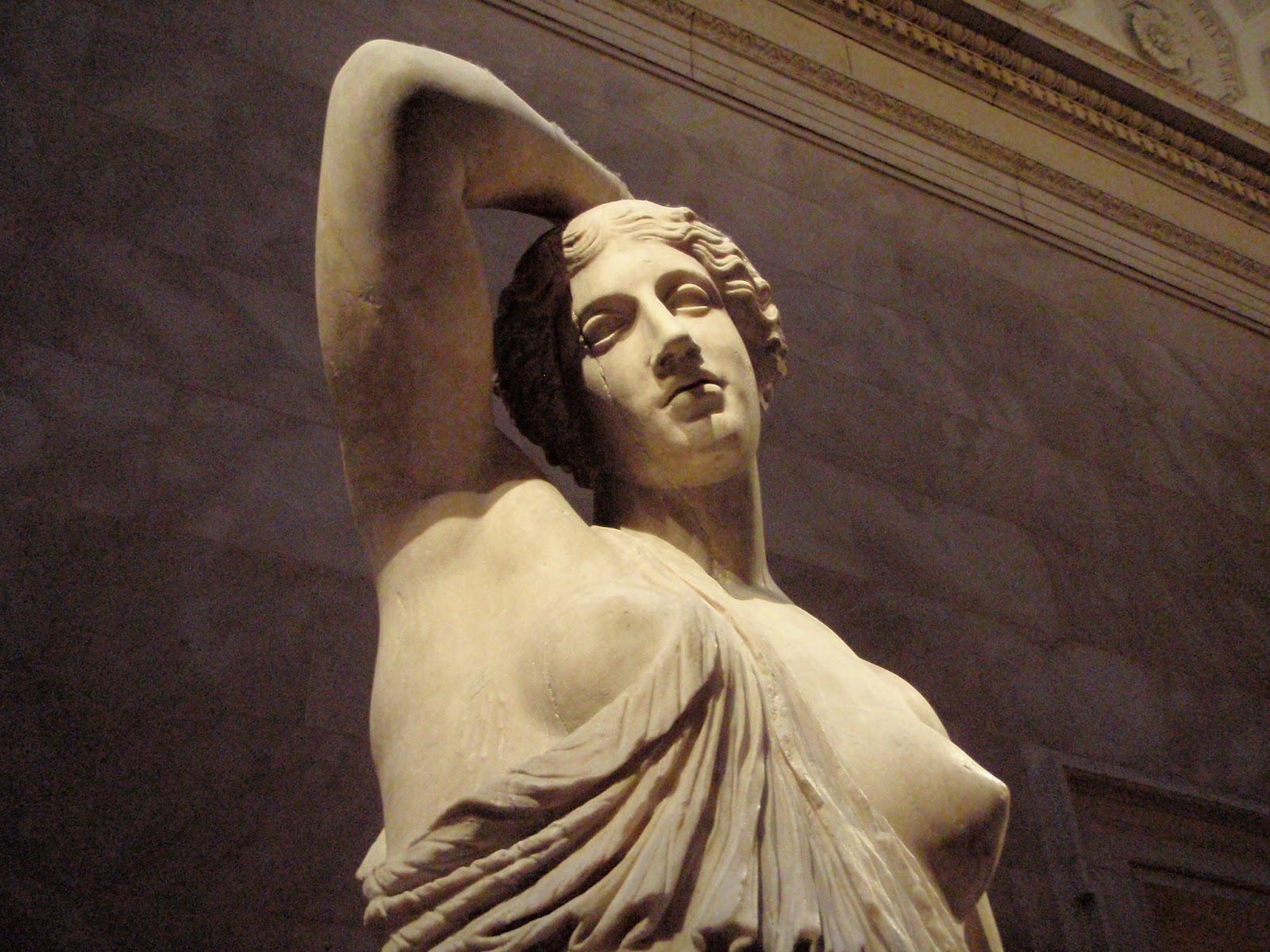
(The second photo was taken at the San Francisco Legion of Honor; the others are from the Metropolitan Museum's classical galleries.)

11 March 2013

Poem of the Week 2013/11

Here is a villanelle: that is, a nineteen-line poem (five tercets and a concluding quatrain) that uses only two rhymes throughout and that uses the first and third lines of the first tercet as alternating stanza refrains, bringing them both together in the last two lines of the quatrain. If that sounds confusing, just read the poem and you'll see how it works. This is by Mark Ford, a contemporary British poet.

A few weeks ago, we saw Housman extending a fragment of Sappho into a new poem. This week, Ford also uses the ancient Greek poet, ingeniously incorporating several of her surviving fragments into a modern structure, much as some medieval builders incorporated random blocks from classical ruins to create something new. Housman's and Ford's poems are both openly derived from Sappho, but a subtler version of her influence is built into the DNA of most European-language lyrics (especially love lyrics), even though much of her work, like that of most classical authors, is now lost: her influence on the subsequently influential, particularly such Roman poets as Horace and Catullus, makes her one of the great if sometimes indirect well-springs of world poetry.

Fragments

When dawn, wearing golden sandals, awoke me,
I began to crawl, burning, shivering, to my uncurtained window;
Migrating birds streamed over the dark sea.

Who can quench the ingenious fires of cruelty?
I was dreaming of white-fetlocked horses conferring in a meadow
When dawn, wearing golden sandals, awoke me.

On my stopped loom, a sort of landscape: icy
Peaks, serrated as daggers, a corpse, and beside it a crow,
And migrating birds streaming over the dark sea.

Fat, autumnal flies alight on my sheets, rainbow-hued, dizzy;
This one on my wrist - its mandibles quiver, its gibbous eyes glow. . . 
Then dawn, wearing golden sandals, awoke me.

Merciless daughter of Zeus, immortal Aphrodite,
Come to me, sing to me, low-voiced, in sorrow
Of migrating birds that stream over the dark sea.

Cast aside your spangled headband: in my mirror I see
You beneath these stringy locks, puckered lips, and tear-stained cheeks . . . go,
Migrating birds, stream over the dark sea;
And dawn, wearing golden sandals, awake me.

[Author's] Note: "Fragments" makes use of a number of images from the poetry of Sappho.

Mark Ford

Ford strikingly captures that half-waking, half-dreaming state as we move towards dawn, where one thing slips into another and then back again, and the menaces of the night give way hazily to the menaces of the morning. The repetitions inherent in the structure of a villanelle work brilliantly to bring out the obsessive, circular nature of this state. There is a pervading sense of loss and threat; the migrating birds definitely seem to be fleeing rather than just migrating; strange, surreal landscapes appear, icy, with a corpse and a crow; flies seem lazy and colorful and then as if in close-up we see their horrible jaws and bulging eyes. The appearance towards the end of Aphrodite, who is merciless yet sorrowful and who melds with the poet's haggard image, implies that it's erotic loss and failure haunting these dreams.

This is from the anthology Villanelles, edited by Annie Finch and Marie-Elizabeth Mali, from the Everyman's Library Pocket Poetry series. Amazon has other Mark Ford books here.